Menu
Menu
Your Cart

e-Gizmo Low Cost Rain and Water Level Sensor Module V2
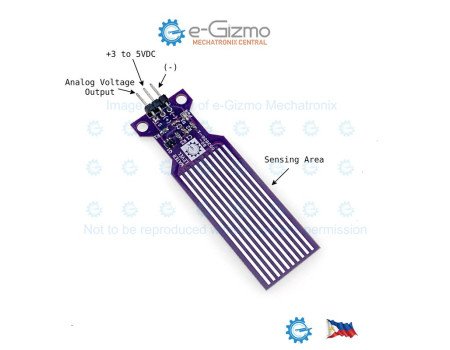
e-Gizmo Low Cost Rain and Water Level Sensor Module V2
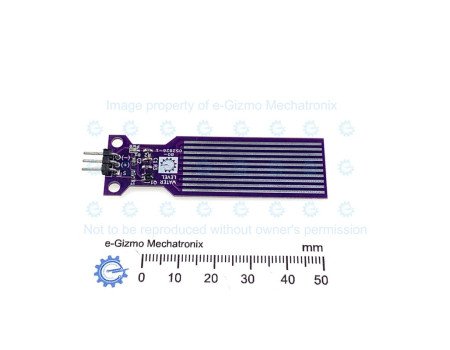
New
e-Gizmo Low Cost Rain and Water Level Sensor Module V2
₱25.00
  • Stock: In Stock
  • Brand: e-Gizmo
  • Product Code: 211100067

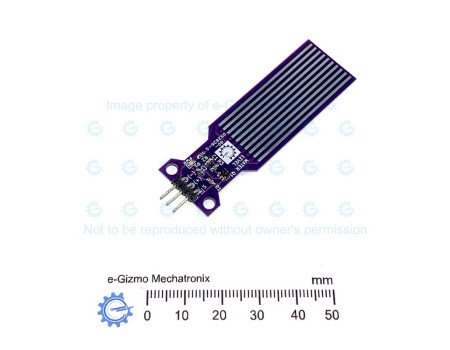
This simple rain/water level sensor detects the presence of water by presenting an ohmic resistance at its output caused by water bridging its conductive probes. The amount or level of water can be estimated and is inversely proportional to the resulting resistance.

This is an improved version of the generic kit offered by other shops:
- Improved noise rejection
- More ESD resistant

The function and appearance remain essentially the same as the generic model to minimize the need to change existing project documentation and code examples.
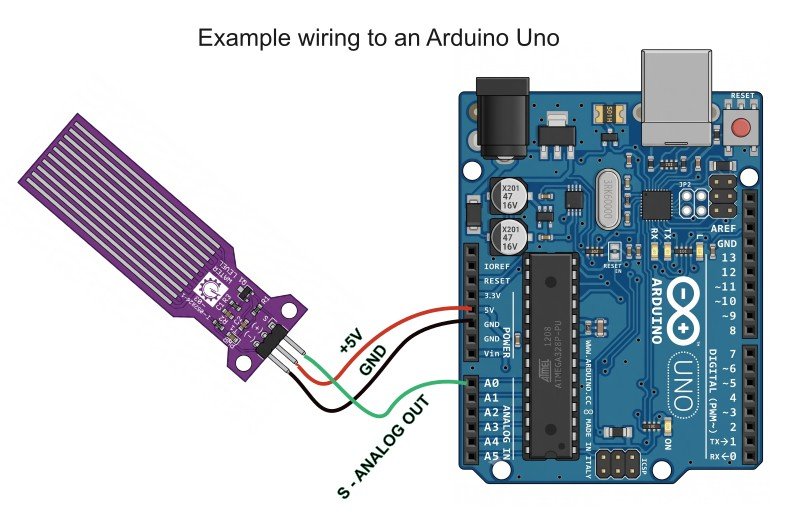
Water Level Sensor
Specifications
Specs

Operating Voltage: 3-5VDC
Output: Analog (voltage output at terminal S)
Detection area: 40x16mm
Probe Type: FR4 PCB comb pattern.

Additional Info
Details

Theory of Operation: Resistive Water Level Sensor
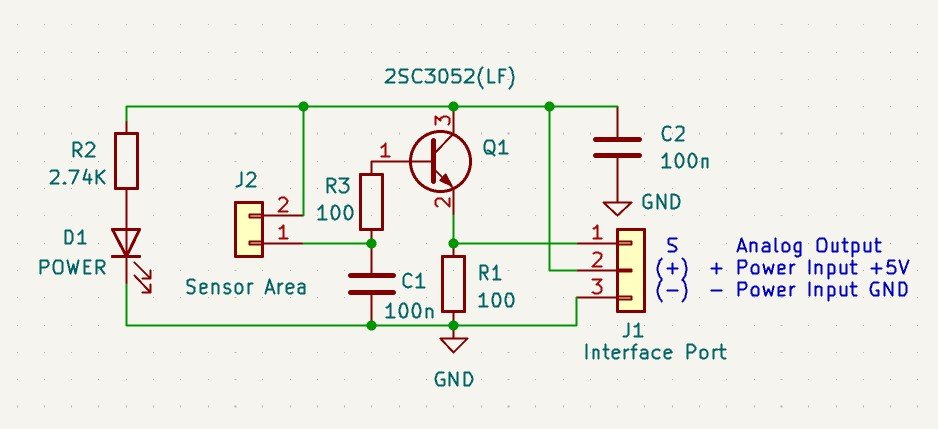
This module functions as a variable resistor that changes its resistance based on its depth of immersion in a conductive liquid (like tap water).
1. The Sensing Mechanism
- Interleaved Traces: The "Sensing Area" consists of alternating, parallel conductive traces exposed on the PCB. One set of traces is connected to the supply voltage (+), and the adjacent interleaved set is connected to the signal conditioning circuit.
- Liquid Conductivity: When dry, the air acts as an insulator, creating an open circuit (extremely high resistance) between adjacent traces. When submerged, the water bridges the gap between these interleaved traces. Because typical water contains dissolved ions, it conducts electricity.
2. Resistance vs. Water Level
- Deep Submersion = Lower Resistance: As the water level rises, a larger surface area of the traces is submerged. This provides more parallel conductive paths for current to flow through the liquid, which decreases the overall electrical resistance between the traces.
- Shallow Submersion = Higher Resistance: When the water level is low, fewer paths are available, resulting in a higher electrical resistance.
3. Signal Conditioning and Output
- Voltage Divider/Amplifier Circuit: The onboard components—including the transistor (Q1), resistors, and capacitor—form a basic signal-conditioning circuit (often a voltage divider or an emitter-follower amplifier).
- Analog Voltage Output: This circuit converts the shifting resistance of the sensing pads into a proportional analog voltage at the S pin:
-- Dry / Low Level: Lower voltage output (near 0V).
-- High Level: Higher voltage output (approaching the +3 to 5VDC supply voltage).

Note: Because this sensor relies on direct electrical contact with water, it is highly susceptible to electrolysis and corrosion over time if powered continuously. To extend its lifespan in practical applications, it is best to only apply power to the (+) pin right before taking a measurement, and turn it off immediately after.

Schematic

Prices and stock availability subject to change without prior notice. If you want this product but it indicates it is not in stock, chat us or simply add it to your cart anyway. Our staff will contact you to inform if we can/cannot provide the item in your order.